
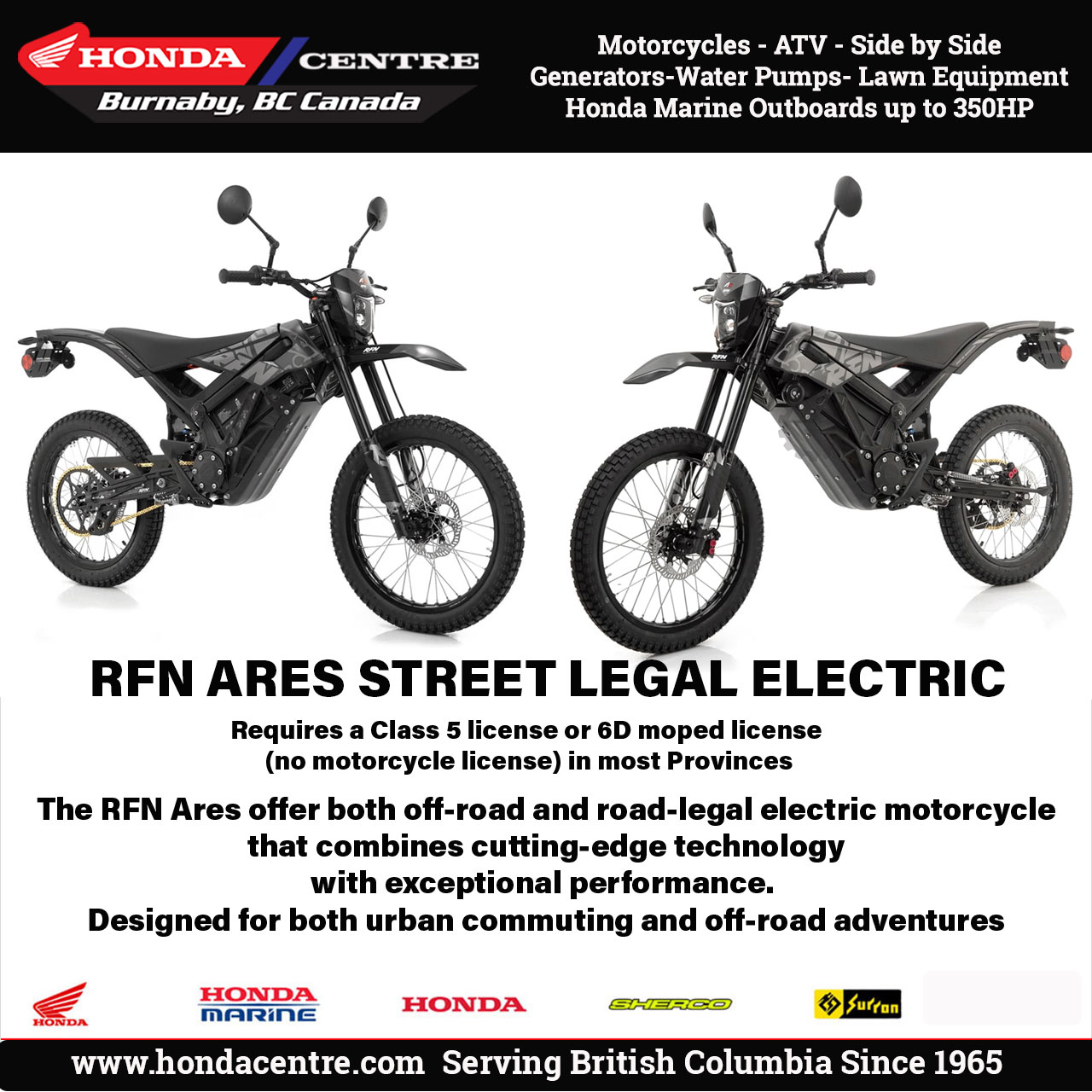
Since 1965, Northwest Motor Corporation — The Honda Centre — has listened to its customers.
They say “One of our core strengths has always been simple: we listen first, then respond. “That approach has guided their service offerings and the product categories they carry, including a move into electric motorcycles.

Their Electric Division was created in direct response to customer questions. Riders wanted to know where electric motorcycles fit, whether the technology was ready, and what options were available in Canada. In response, they added leading electric motorcycle brands to the lineup including Surron, Talaria, NIU, and RFN all widely recognized as world leaders in electric off-road and light-duty motorcycles. The Honda centre says ” the strong acceptance by our customers confirms that listening works.”
They go on to exlain that first and foremost, they are a Honda Powersports dealer. Honda does manufacture electric products, but electric motorcycles are not currently available for sale in Canada. That said, the direction is clear. Honda Power Equipment Division introduced Honda electric-powered lawnmowers in 2025, followed by unveiling its first electric motorcycle the WN7 at EICMA in Milan, signaling a serious commitment to electrification.

With performance comparable to a 600cc motorcycle, the WN7 shows where Honda is heading.
In the electric scooter category, Honda’s focus is primarily on Asia-Pacific and European markets, where population density is high and scooters and motorcycles are often the main form of transportation. To meet its carbon-neutrality goals, Honda needs to sell electric scooters in very large volumes. Canada, with its vast geography and long riding distances, presents a different challenge — one that still requires greater range than today’s electric street motorcycles can consistently provide.

This is why most electric motorcycles currently available in Canada are off-road motorcycles, often referred to as electric dirt bikes. Off-road riding aligns perfectly with the strengths of electric technology: instant torque, quiet operation, low maintenance, and predictable riding distances. At the same time, it avoids the key limitations that affect electric street motorcycles, particularly range and sustained high-speed efficiency.
For example, the street-legal NIU XQi3 electric dirt bike offers a real-world range of approximately 80–90 km (50–55 miles) on a single charge. That range works well for its intended use, but it also highlights why electric adoption in Canada looks different than in many other parts of the world.

Electric motorcycles are not here to replace internal combustion motorcycles — and they don’t need to. They simply add another tool to the riding landscape. This will change as the distance problem is solved by future technologies like solid state batteries.
The Honda Centre says “As always, our role at The Honda Centre is to listen, learn, and offer products that make sense for the way our customers ride.”
Duncan Fraser



Leave a Reply