
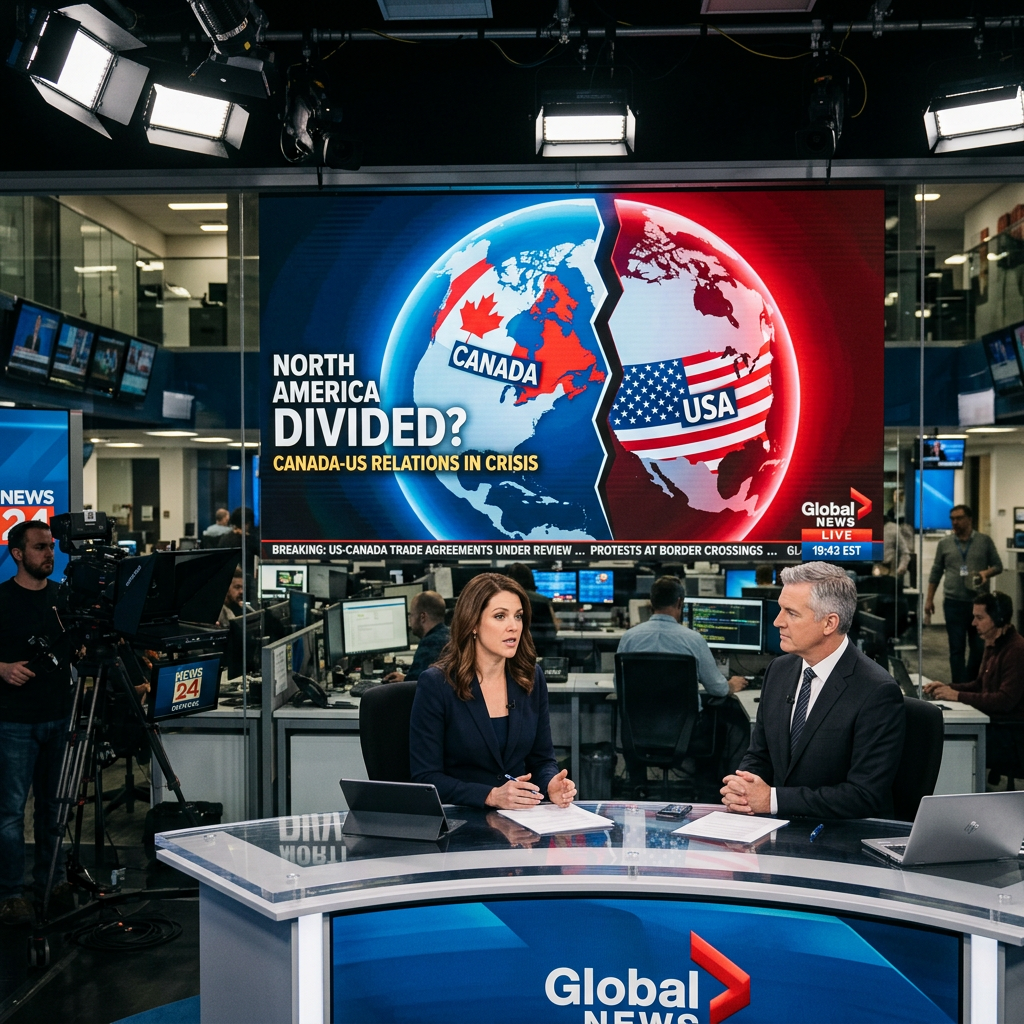
Not the 51st State: A Canadian Reflection on Tariffs, Trust, and the State of the Press
By Duncan Fraser for Winding-Roads.ca
April 17, 2026
This subject takes on more importance as the world becomes increasingly unstable and dangerous in 2026.
Questions surrounding influence, trust, and editorial direction in major media institutions, including The New York Times, reflect a deeper issue: in times of instability.
Ownership matters. It matters when Postmedia, Canada’s largest newspaper chain, is majority owned (roughly two-thirds) by Chatham Asset Management, a U.S.-based hedge fund reported to have ties to the Republican Party.
It matters when senior editorial figures have described parts of the network as “insufficiently conservative,” alongside structural changes that centralized political coverage—moves critics argue were intended to produce more ideologically consistent reporting.


In the United States, shifts in media ownership, tone, and political influence are shaping how events are understood.
There is debate about how far this goes—but few dispute that media environments are becoming more polarized.
June 2, 2025
My project on the Trump Trade War on Canada consisted of me creating over 230 images from the front pages of national and international newspapers and Media Sites and creating and narrating two Videos. One for March and one for April which included the period of the 2025 Canadian federal election. These were posted to my uTube channel at https://www.youtube.com/@winding-roads and to here on my blog www.winding-roads.ca.
In creating this, I typically would come home from work and spend about three hours reading and digesting the headlines then digitize them. There were of course excursions down the proverbial media rabbit holes. Without subscriptions to the newspapers I was limited to what the digital editions provided and could not replicate an in depth review of a headline. Please let me know what you think of my effort
JULY 27, 2025
When is a deal not a deal, I am hesitant to say that the President of the United misinterpreted the truth so it looks like Donald Trump must have misunderstood what was agreed to, which was nothing!

In Canada we are in the process of trying to come to grips with what has been dealt to our country by this Trade War that Trump started with us and our county is united in doing everything it can to survive it. No war escapes casualties and we are a county that understands that. We are devastated that a relationship that was built on decades of mutual trust has been destroyed in less than six months.

On March 3rd, 2025, President Donald Trump made what proved to be a false claim that huge amounts Fentanyl were being smuggled into the United States from Canada. He also has said we should become the 51st. State .
He used the drug claim to justify the opening salvo and leveling Tariffs on Canadian imports which has now escalated into a trade war—one that now threatens workers, businesses, and entire industries across borders. The U.S. Senate has since rejected his justification, confirming what many of us already knew: it was a political stunt with no factual basis.
Prime Minister Justin Trudeau resigned and parliament was prorogued while the Liberal party chose a new leader.
Believing we would be soon heading to the polls I had a concern regarding foreign interference, as the Public Inquiry Into Foreign Interference in Federal Electoral Processes and Democratic Institutions chaired by The Honourable Marie-Josée Hogue pointed out in his report tabled on January 28th.
“The first observation I would like to make from the evidence is that it is true that some foreign states are trying to interfere in our democratic institutions, including electoral processes. This is nothing new and comes as no surprise –states have been trying to interfere with each other’s business since time immemorial. What is new, however, is the means deployed by these states, the apparent scale of the issue and the public discourse on the topic. I have also noted that our democratic institutions have thus far remained robust”
I was interested in how our main steam media would report on Trade War and the federal election so began a project to archive and analyze the front pages of major news outlets around the world.
I wanted to document how the crisis is being reported, whose voices are being heard—or silenced—and how different media ecosystems interpret the same moment in time.
I was also concerned that a Conservative party leader would refuse to get the security clearance necessary to review the security data that the foreign interference report based some of its report on. This is data that for security reasons could not be released and that all the other party leaders have.
I chose to digitized the front pages from the BBC, CBC, New York Times, Globe and Mail and the Vancouver Sun and occasionally the Japan Times. The Vancouver Sun which has been notably quiet on the gravity of the trade war and this was a concern for me as it is owned by Postmedia a right leaning Media conglomerate based in New York.
The Japan Times is Japan’s largest and oldest English-language daily newspaper and the Japanese love newspapers.
I concluded the project on April 30th after Canada’s federal election on April 28th. and created two narrated videos created from front pages. The videos will be available on my video blog on uTube at Duncan Fraser Reads so please click on them and leave a comment and share if you care

The Video below consists of 86 Front pages from March, 2025. Please like it if you do and share if you care.
April 30th. 2025
Canada has chosen a new leader Marc Carney who will be charged with what some have called called a new word order created by Donald Trump’s Trade War. It will be a from a minority position in Parliament that he enters the arena to deal with Donald Trump.
It will be a test for all Canadians to put their personal politician affiliations aside and work together to weather the economic storms that are coming. Together we have strength and if we put our personal differences aside a strong and united Canada will emerge.

April 27, 2025 5pm:
It is the eve of our Federal Election here in Canada where our New Leader will be chosen to Fight for us in the Trade War with Donald Trumps USA. All that concern and angst came to a screeching halt for me today when cheers turned to tears at a Filipino celebration in Vancouver. A madman drove into a crown killing 11 people and know that with the mounting death toll in the Ukraine, Gaza and the Congo that this may be a fraction of their pain but these are our neighbours and my heart is broken


April 17,2025


My goal is not only to capture facts but to trace how the framing of truth differs depending on who owns the press.
And ownership matters. It matters when Postmedia, Canada’s largest newspaper chain, is two-thirds owned by Chatham Asset Management, a U.S.-based firm with deep ties to the Republican Party.
It matters when senior editorial figures within Postmedia call their own network “insufficiently conservative” and restructure reporting to ensure more ideologically aligned coverage.
When a foreign-owned media conglomerate influences the political narrative of a sovereign nation during an election and a trade war, we must ask: what’s the difference between that and foreign interference?

April 4th, 2025 – A Snapshot of the Press: What Did They Choose to Tell Us?
The two most pressing issues facing Canadians:
- A rapidly escalating Trade War with the United States, triggered by misinformation and now entering global territory.
- An upcoming Federal Election on April 28th, with the central question: Which leader can best stand up for Canada on the global stage, particularly against Donald Trump?
On this day, I captured the front pages of:
- BBC (UK)
- CBC (Canada)
- The New York Times (USA)
- The Toronto Star
- The Globe and Mail
- The Vancouver Sun
This visual comparison highlights not just what’s being reported—but what’s being left out. And in that silence, we can see the shape of influence.

In Vancouver, a city with global connections, economic vulnerability to U.S. trade policy, and a long history of activism and press independence, The Vancouver Sun’s decision to underreport or soft-pedal the trade war raises questions. Is this an editorial oversight—or an outcome of Postmedia’s central direction toward a “reliably conservative” voice?
Over Coffee in Paris – But What About Canada?
In a recent BBC article, Nicolas Conquer, a dual French-American citizen and head of Republicans Abroad Paris, brushed off concerns about rising tensions due to Trump’s trade policies. He acknowledged “some volatility” from the tariffs but dismissed the broader unease as a “media narrative.” Any backlash against the America First agenda, he claimed, was rooted in a “childish or immature” view of international relations. He also emphasized that France and the U.S. had always been “the oldest allies.”
That comment prompted me to dig a little. He may be referring — knowingly or not — to the 1778 Treaty of Alliance between France and the U.S. during the Revolutionary War. But if Mr. Conquer wants to talk about old alliances, he might want to brush up on Canada’s relationship with France, too. We’re not just neighbours of the U.S.—we’re a bilingual nation with French and English as official languages, and our cultural and historical ties to France run deep.
Quebec, Acadia, Métis francophone communities — all are part of our fabric. Canada and France stood side by side in two world wars, and continue to collaborate on trade, education, diplomacy, and culture.
So when Americans abroad talk about “old allies,” I’d hope they’d remember the one just north of their border, too.
—Winding Roads
WHY DO I CARE
As a Canadian by choice and a Scot by birth, I take this personally. I was born in a country that fought tyranny, and I chose to live in one that believes in fairness, decency, and the rule of law. Canadians stood with Britain before the United States in both World Wars. The blood of Canadian and American youth still stains the beaches and fields of France. So when Donald Trump casually refers to us as the “51st State,” I don’t just hear arrogance—I hear the erasure of a friendship forged in sacrifice by both countries.

I love the United States. I’ve travelled extensively in that remarkable country and have deep respect for its people. But this attack on America’s closest ally—on its best friend—will take a long time to heal. And it won’t just hurt Canadians. It will devastate millions of hardworking Americans, too, along with families and businesses across the globe.
April 13 – Trade War, Day 40: A Personal Reflection
I’ve had the privilege — through business, motorcycles, and a bit of good luck — to travel across Canada, the U.S., and parts of Europe.
I’ve spoken to audiences in England, Germany, the USA, and Canada, and visited convention centres and cities that live and breathe international cooperation.
From Laguna Seca to Daytona, from Atlanta, New Hampshire, Washington, Oregon, and the desert of Baja — these places aren’t just destinations to me. They’re moments, memories, and human connections.
I’ve walked through:
- The Wembley Conference Centre in London
- The Gaylord Opryland Centre in Nashville
- The vast Orlando Convention Center in Florida
- Business hubs in Frankfurt, San Diego, and New Orleans

These aren’t just dots on a map — they’re economic ecosystems. They depend on trade, open dialogue, and the kind of cross-border cooperation that trade wars threaten to unravel.
And now, watching this Trump-led U.S. trade policy radicalize, I feel the tension tightening not just as a Canadian — but as someone who’s stood in those places, shaken hands, raced motorcycles, made deals, and shared stories.
This isn’t just theory. It’s not just politics. It’s personal.
And it’s sad to see places I’ve connected with used as pawns in something that should never have been a game.
—Winding Roads
We’ve seen what trade wars can do. The Smoot–Hawley Tariff Act of the 1930s triggered a spiral that helped turn a financial crash into a global depression. We don’t need to repeat that mistake. Not now. Not again.
So I continue to watch, and archive, and reflect—not because I expect to change the minds of politicians, but because history deserves a witness. Because truth, however fragile, must be protected. And because maybe, just maybe, someone will listen before it’s too late.
Some of my writing was edited with the help of ChatGPT.



Leave a Reply