

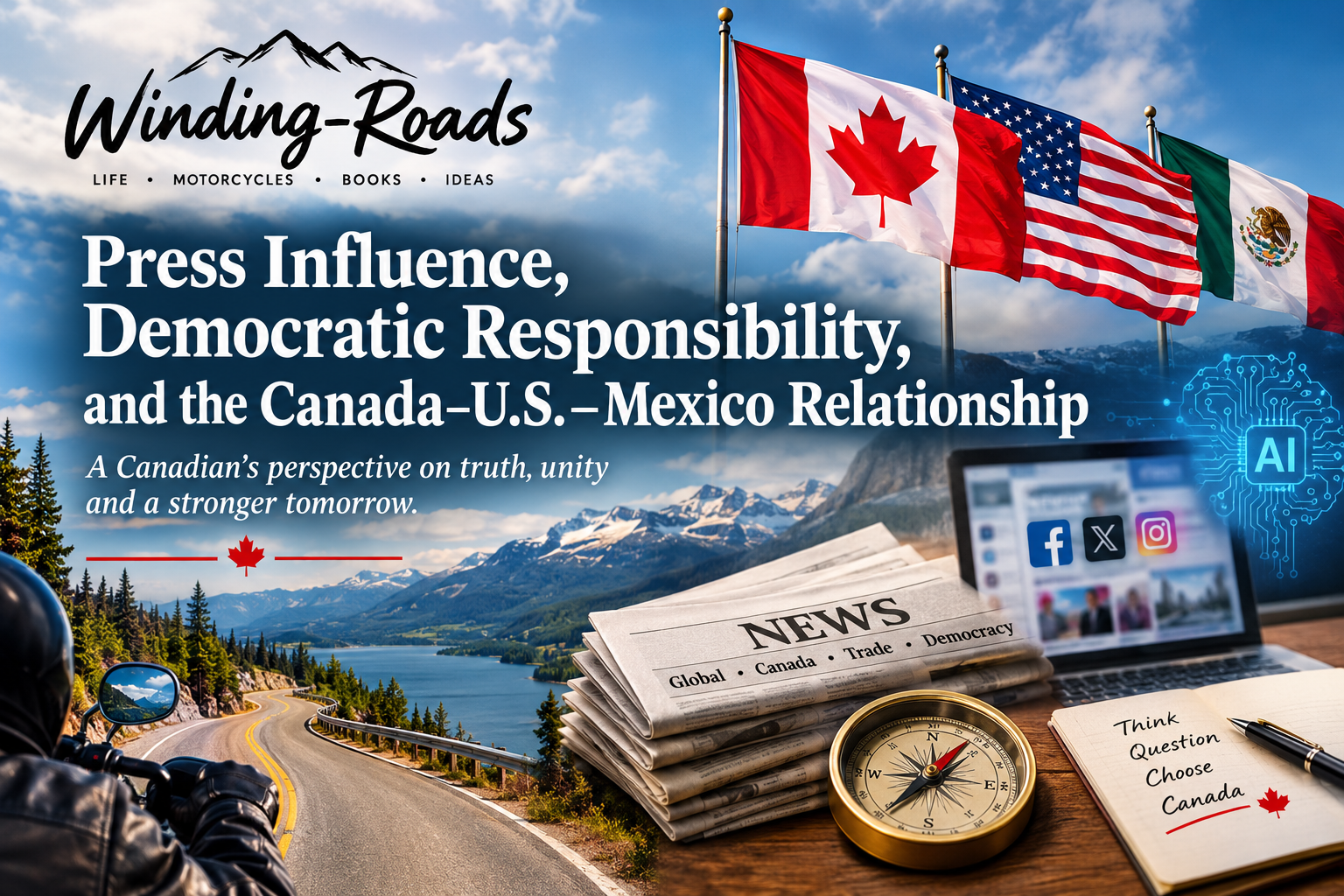
Press Influence, Democratic Responsibility, and the Canada–U.S., Mexico Relationship

I should say something about where I’m coming from.
I’m not an academic, and I didn’t have the advantage of a formal education until I was in my forties. I was a street kid. I’m an immigrant Scot who learned most things the hard way — by paying attention, by staying out of gangs, by avoiding addiction, and by trying to stay alive long enough to learn something useful.
What I carried with me was a simple belief: if you do the best you can, keep learning, and don’t intentionally hurt other people, you can probably count yourself a decent human being — and, in my case, a good Canadian.
This piece builds on earlier work I did earlier during the Trump Trade War with Canada, when I became interested in how the press framing and political language shape public understanding. The concerns I’m raising here aren’t ideological or partisan. They come from a lifetime of watching how words influence behavior, and how easily judgment can be nudged when narratives are repeated often enough.
In a time when political language can be generated, scaled, and deployed without a human voice behind it, I think it matters that ordinary people continue to speak for themselves — clearly, carefully, and in their own words.
That’s all I’m trying to do here.
As a Canadian entering my eighty-first year, I have lived through periods of economic uncertainty, geopolitical tension, and political upheaval before. What distinguishes the present moment is not simply the number of global crises unfolding simultaneously — war in Ukraine, devastation in Gaza, a largely ignored catastrophe in Sudan, and increasingly volatile posturing by Iran — but the way political narratives now move at scale, often untethered from human authorship or accountability.
In such an environment, rhetoric matters. Language hardens positions, narrows options, and can inflame situations already under strain. To examine Canada’s relationship with the United States today without acknowledging this broader global context would be shortsighted. Yet to become consumed by it would be equally unwise. The task is balance — and clarity.
The Public Inquiry into Foreign Interference
WE ARE NOT BLIND
Canada does not approach this moment unprepared. The Public Inquiry into Foreign Interference in Federal Electoral Processes and Democratic Institutions, chaired by the Honourable Marie-Josée Hogue, confirmed what many suspected: foreign states do attempt to interfere in democratic systems. What is new is not the intent, but the means, scale, and velocity of that interference. Equally important, the inquiry concluded that Canada’s democratic institutions have thus far remained robust.
That finding should reassure us — but not relax us.
Leadership and Credibility in a Volatile Era
It is within this context that Prime Minister Mark Carney’s leadership must be understood. Carney brings to office a depth of global economic experience that is rare in modern politics: former Governor of the Bank of Canada, Governor of the Bank of England, chair of Bloomberg L.P., and a central figure in international financial and development institutions.
That background matters. It shapes a governing approach focused on internal resilience, diversification of trade relationships, and a clear-eyed acceptance of the interwoven economic reality of Canada, the United States, and Mexico.
From Editorial Direction to Algorithmic Pressure
My concern about narrative influence did not begin with artificial intelligence. During the Trump-era trade dispute with Canada, I spent a great deal of time examining how press coverage and framing shaped public understanding of events with real economic consequences.
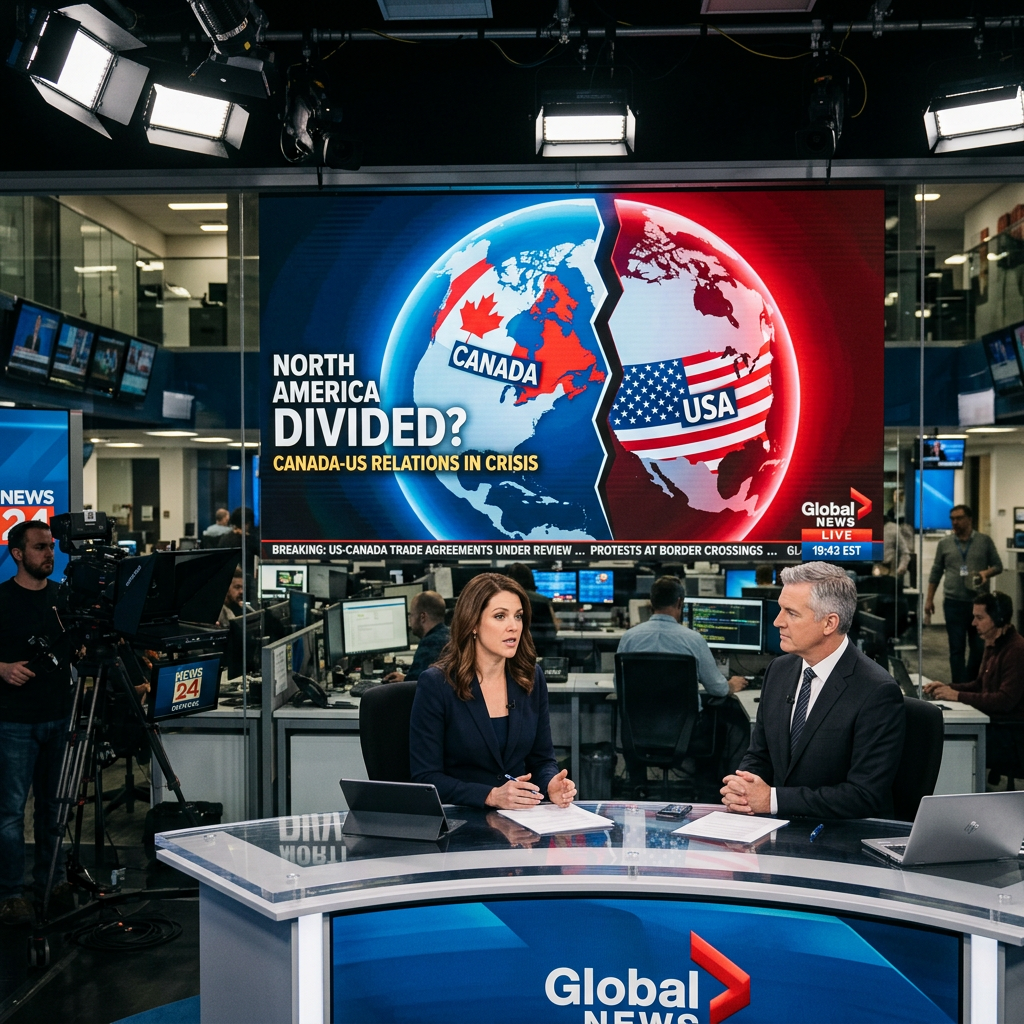
Canada has already seen how concentrated media ownership can influence tone and emphasis. When Postmedia reportedly instructed its newspapers that their coverage was “not conservative enough,” it demonstrated how editorial direction — without altering facts — can shift perception across an entire media ecosystem.
If that level of influence is possible through traditional editorial structures, it is not difficult to imagine what can be achieved through automated AI systems operating at scale.
The 2026 Trade Review and the Risk of Distortion
As Canada approaches the 2026 review of the North American trade agreement, the risk is not that public debate will be vigorous — it should be — but that parts of that debate may be artificially shaped, scaled, or steered.
A Responsibility Beyond the Ballot
Every democracy depends on participation, but participation is more than marking a ballot every few years. It rests on citizens willing to think clearly, speak honestly, and resist surrendering judgment to noise.
Clear thinking is not a luxury in a democracy. It is a duty.
RECENT CANADIAN UPDATE:

Footnotes
- Public Inquiry into Foreign Interference in Federal Electoral Processes and Democratic Institutions (Final Report), chaired by the Honourable Marie‑Josée Hogue, tabled January 28, 2025. The inquiry found that while foreign interference efforts are real and persistent, Canada’s democratic institutions have remained robust, with new risks arising primarily from scale, technology, and information velocity.
- Mark Carney – Background and Experience. Former Governor of the Bank of Canada (2008–2013), Governor of the Bank of England (2013–2020), former Chair of Bloomberg L.P., and co‑chair of World Bank‑affiliated private‑sector investment initiatives. These roles are widely cited in public records and international financial literature.
- Canada–United States–Mexico Agreement (CUSMA / USMCA). The agreement contains a mandatory six‑year review clause scheduled for 2026, making the lead‑up period particularly sensitive to political signaling, public narrative formation, and domestic pressure in all three countries.
- Postmedia Network Editorial Direction. Public reporting has documented instances in which Postmedia leadership urged a more explicitly conservative editorial stance across its newspaper chain. While lawful, this episode illustrates how concentrated media ownership can influence framing and tone without altering underlying facts.
- AI‑Generated Political Content. Contemporary research on information integrity consistently identifies amplification, repetition, and simulated consensus — rather than outright fabrication — as the primary risks posed by AI‑generated political material.
Author’s Note
I used ChatGPT as an editorial aid to tighten and clarify my original draft. My unedited writing — shaped by a life that did not include formal education until much later — contained grammatical and spelling errors that distracted from the substance of what I was trying to say.
The ideas, concerns, and conclusions in this piece are my own. The use of an AI tool was limited to editing for clarity, structure, and readability, not to generate arguments or viewpoints. I disclose this deliberately, because transparency about authorship matters — especially in an era when artificial voices increasingly blur the line between assistance and authorship.


Leave a Reply